

When I Have Decided To Obey—Why Am I Still Not Doing It?
Understanding and Overcoming the Resistance That Keeps Us From Following Through With God
CENTRAL TRUTH
Sometimes the problem is no longer that we do not know what God wants. The problem is that something within us continues to resist carrying out what we already know.
ANCHOR SCRIPTURES
“For it is God who works in you both to will and to do for His good pleasure.”
— Philippians 2:13
“Be doers of the word, and not hearers only.”
— James 1:22
“Not My will, but Yours, be done.”
— Luke 22:42
INTRODUCTION
I SAID YES—SO WHY IS IT STILL UNDONE?
Before we go any further, we need balance.
Many of us have obeyed God in significant ways.
We have served.
We have helped others.
We have prayed when someone needed us.
We have carried ministry responsibilities.
We have given.
We have shown up.
We have fulfilled commitments because people were depending on us.
So this message is not saying that we are generally disobedient people.
There are areas in our lives where the grace of God has clearly produced obedience, faithfulness, and follow-through.
But there may also be another reality:
We can be faithful in what concerns others while repeatedly postponing what God has personally entrusted to us.
We will help someone else complete their assignment while our own remains unfinished.
We will pray for someone else’s breakthrough while postponing a personal discipline the Holy Spirit has been dealing with us about.
We will meet a ministry deadline while repeatedly moving our own God-given project into another week.
We will encourage somebody else to confront fear while avoiding the very thing God has asked us to face.
We will make time because someone needs us, yet continually tell ourselves that we do not have time for what God has privately impressed upon us.
And that raises a deeper question:
Why can I respond so readily when someone else needs something from me, yet struggle to follow through when God gives me a personal assignment?
That is where this message is going.
Not merely:
“Why don’t I obey?”
But:
“Why is this particular obedience so difficult for me?”
There are things some of us have been meaning to do for a long time.
Not things we are still genuinely uncertain about.
Things we already know.
The call we were supposed to make.
The apology we intended to give.
The assignment we were supposed to complete.
The discipline we said we would begin.
The thing we know God told us to stop—or start.
We said:
“Lord, I will do it.”
And we meant it.
Yet it remains undone.
Days became weeks.
Weeks became months.
And perhaps months became years.
So here is the question:
How can I sincerely want to obey God and still repeatedly fail to follow through?
This message is not primarily for the person saying:
“I will not obey God.”
It is for the person saying:
“I want to obey. I have decided to obey. Why am I still not doing it?”
The answer may be deeper than lack of discipline.
We need the Holy Spirit to help us discern:
“What is happening inside me after God speaks but before I act?”
Because formation becomes visible when what God says moves from something we agree with to something we actually do.
1. A DECISION TO OBEY IS NOT YET OBEDIENCE
There is a difference between intention and action.
We may say:
“I will forgive.”
“I will start.”
“I will finish.”
“I will apologise.”
“I will obey what God told me.”
But James says:
“Be doers of the word, and not hearers only.”
— James 1:22
There can be a gap between:
God speaks → I decide → I act.
And sometimes the greatest battle happens in that gap.
God spoke.
I agreed.
But then fear rose.
I felt overwhelmed.
Other things became urgent.
I started overthinking.
I waited until I felt ready.
And gradually, my sincere yes became an unfinished assignment.
Here is the truth:
Good intentions are not the same as obedient action.
That is not condemnation.
It is clarity.
Our intention may be sincere, but obedience is not complete until our response moves from decision into action.
Reflection
What have I sincerely intended to do but still have not done?
Sample answers:
“I have sincerely intended to complete the personal project God placed on my heart, but I keep postponing when I will actually work on it.”
“I have intended to have an important conversation and make things right, but I keep delaying because I do not want to face the discomfort.”
2. WHAT IS ACTUALLY RESISTING OBEDIENCE?
Not all resistance has the same root.
Sometimes the issue is:
- fear;
- unbelief;
- distraction;
- overwhelm;
- perfectionism;
- avoidance;
- comfort;
- self-will;
- people-pleasing;
- poor planning;
- an old learned pattern or habit;
- or spiritual opposition.
Sometimes several things are operating together.
That is why simply saying, “I need to be more disciplined,” may not address what is really happening.
Instead of only asking:
“Why haven’t I done it?”
Ask:
“What happens inside me when I think about doing it?”
Do I become afraid of failing, criticism, or the outcome?
Do I feel overwhelmed because the assignment seems too large?
Do I suddenly feel tired, heavy, or unmotivated?
Do I become distracted and start doing easier things instead?
Do I tell myself, “I need more time—I’ll do it later”?
Do I overthink where to begin or feel that I must have everything figured out first?
Do I feel that it has to be perfect before I can move forward?
Do I resist because of what obedience will cost me in time, comfort, effort, or change?
Or, deep down, do I simply not want to do what God is asking?
Pay attention to the pattern.
What repeatedly happens inside you may reveal what is actually resisting your obedience.
This is where discernment begins.
3. SPIRITUAL HINDRANCES
A. Lack of Trust
Sometimes unfinished obedience exposes where trust is not yet settled.
Biblical trust is more than saying:
“I believe God can.”
It means relying on who God is enough to follow what He says.
Proverbs 3:5 tells us:
“Trust in the LORD with all your heart, and lean not on your own understanding.”
To trust God means:
- I believe He knows better than I do.
- I believe His intentions toward me are good.
- I believe His wisdom is greater than mine.
- I believe He can be trusted with the consequences of my obedience.
- Therefore, I place the outcome in His hands and follow Him.
This is where obedience exposes trust.
I may believe God generally and still struggle to trust Him with this particular outcome.
“Lord, if I obey, what if I fail?”
“What if they reject me?”
“What if I lose something?”
“What if it does not work?”
“What if I cannot handle what comes next?”
Sometimes delay is quietly saying:
“God, I know what You said, but I still feel safer controlling what happens next.”
Trust is taking God at His Word enough to place the consequences of obedience in His hands.
Reflection
What am I afraid will happen if I fully obey God in this matter—and do I trust Him with that outcome?
Sample answers:
“I am afraid that if I obey, I may fail or be disappointed. Trust would mean taking the step anyway and leaving the result with God.”
“I am afraid that obeying may upset someone or change the relationship. Trust would mean doing what God has asked with love and humility and trusting Him with how the person responds.”
B. Distraction and Busyness
Not every delay looks rebellious.
Sometimes the instruction simply gets buried beneath competing demands.
You intended to do it.
Then something else became urgent.
Then another thing.
Then another.
And gradually, the assignment moved to the bottom of the list.
This is important:
Busyness can become a respectable hiding place for disobedience.
We can be productive with many things and still neglect the one thing God told us to do.
Busyness is not always the problem.
Sometimes the deeper issue is priority.
What we repeatedly make room for reveals what we have allowed to carry weight in our lives.
Reflection
What am I allowing to remain urgent that is repeatedly pushing God’s instruction to the bottom of my list?
Sample answers:
“I keep responding to everyone else’s needs first, so the personal assignment God gave me is always postponed.”
“I stay busy with easier or more immediate tasks because they make me feel productive, while avoiding the one thing I know I need to complete.”
C. Repeated Delay Can Make Resistance Feel Normal
Hebrews says:
“Today, if you will hear His voice, do not harden your hearts.”
— Hebrews 3:15
The first time God deals with something, conviction may feel strong.
But repeated postponement can make non-response familiar.
Eventually, we learn to live beside the unfinished matter.
It remains there, but it no longer troubles us as deeply.
And that is dangerous because:
We can become comfortable with something God never told us to leave unfinished.
What once disturbed our conscience can become part of the furniture of our lives.
We see it.
We know it is there.
But we have learned to walk around it.
Reflection
Is there something God has repeatedly brought to my attention that I have now learned to live with unfinished?
Sample answers:
“God has repeatedly reminded me to complete a personal assignment, but because I have delayed it for so long, I no longer feel the same urgency about it.”
“God has been dealing with me about having an important conversation, but I have become used to avoiding it and carrying on as though the matter is settled.”
D. Spiritual Opposition Is Real—but It Is Not Always the Explanation
Ephesians 6 reminds us that spiritual opposition is real.
But James 4:7 gives us an important order:
“Submit to God. Resist the devil.”
We should not blame spiritual warfare for everything.
Sometimes the issue is spiritual opposition.
But sometimes the issue is:
fear;
poor discipline;
poor planning;
avoidance;
or self-will.
Discernment means we neither deny spiritual warfare nor use spiritual warfare to avoid personal responsibility.
There are moments when we need to pray, resist, stand, and contend.
There are other moments when we need to open the calendar, turn off the phone, make the call, apologise, sit down, and do what we already know to do.
Reflection
What part of the resistance I am experiencing requires spiritual warfare—and what part requires me to take personal responsibility?
Sample answers:
“Part of the resistance may be spiritual. I experience unusual discouragement and distraction whenever I move toward the assignment. I need to pray, stand in faith, and resist what is opposing God’s will.”
“Part of the resistance is mine. I have not planned properly, protected time for the task, or followed through consistently. I need to stop calling everything warfare and take responsibility for the practical steps I can take.”
4. PSYCHOLOGICAL AND EMOTIONAL RESISTANCE
Understanding learned emotional and behavioural patterns does not remove personal responsibility.
It helps us recognise what must be healed, renewed, disciplined, and brought under the lordship of Christ.
A. Fear of Failure
Sometimes we delay because beginning creates the possibility of failing.
As long as the assignment remains unfinished, it cannot be judged.
We can still imagine what it might become.
But once we begin, our work becomes visible.
Someone might criticise it.
We might make mistakes.
It may not turn out as we expected.
So delay can become a form of self-protection.
But it also keeps us from obedience.
God did not ask us to guarantee success.
He asks us to be faithful.
Our responsibility is obedience.
The outcome belongs to Him.
B. Perfectionism
Perfectionism may sound spiritual:
“I just want to do it properly.”
But underneath that statement may be fear:
“What if it is not good enough?”
Ecclesiastes 11:4 says:
“He who observes the wind will not sow.”
If every condition must be perfect before we begin, we may never begin.
There is nothing wrong with excellence.
But excellence and perfectionism are not the same.
Excellence serves obedience. Perfectionism can prevent it.
Excellence says:
“I will faithfully give God my best.”
Perfectionism says:
“I cannot move until I am certain it will be flawless.”
One moves in faith.
The other can keep us frozen.
C. Overwhelm
Sometimes the assignment feels too large.
“Write the book.”
“Repair the relationship.”
“Organise the ministry.”
“Put the finances in order.”
“Broadcast the message.”
The whole assignment feels difficult when we look at everything at once.
But God may give a large assignment that requires many small acts of obedience.
Today’s obedience may simply be:
open the document;
make the call;
list what needs to be done;
gather the information;
schedule one hour;
complete one section.
Do not confuse the size of the assignment with the size of today’s obedience.
You may not be able to complete the whole assignment today.
But you can obey the next step.
D. Avoidance of Discomfort
Sometimes we are not really avoiding the task.
We are avoiding how the task will make us feel.
An apology may feel humiliating.
A difficult conversation may produce anxiety.
Starting something new may make us feel uncertain.
Admitting we were wrong may be painful.
Changing a habit may make us uncomfortable.
So we need to ask:
“Am I resisting the assignment—or am I resisting the discomfort that obedience requires?”
Discomfort is not always a warning to stop.
Sometimes discomfort is simply what surrender feels like when our will is being challenged.
5. SELF-WILL: THE DEEPER CONFLICT
Now we come to something deeper: the will.
Sometimes we genuinely want God’s will—but we also want something else.
God says forgive.
I want peace, but I also want to hold on to the offence.
God says apologise.
I want restoration, but I do not want the humiliation.
God says begin.
I want the finished assignment, but I do not want the sacrifice.
I want resolution, but I do not want the discomfort of saying what needs to be said.
This is why Gethsemane matters.
Jesus prayed:
“Not My will, but Yours, be done.”
— Luke 22:42
Jesus did not pretend that He had no personal desire.
He brought His desire honestly before the Father.
But His desire did not become His lord.
Surrender does not mean I have no preference. It means God’s will has final authority.
This is one of the deepest places where obedience forms Christ in us.
We do not become obedient because we never want anything different.
We become obedient when, even in the presence of competing desires, we yield our will to the Father.
Reflection
Where is my preference still competing with God’s will, and what would surrender look like in that area?
Sample answers:
“I prefer to avoid the conversation because I do not want conflict, but I sense God wants me to address the issue honestly. Surrender would mean having the conversation with humility and love.”
“I prefer to use my time on things I enjoy or that feel easier, but God has been prompting me to complete a personal assignment. Surrender would mean giving that assignment regular, protected time and following through even when I do not feel motivated.”
6. WANTING TO OBEY IS NOT THE SAME AS BEING WILLING TO OBEY
This is a key distinction.
I may want the outcome of obedience without being willing to embrace what obedience requires.
I want the completed book.
Am I willing to write?
I want the restored relationship.
Am I willing to have the uncomfortable conversation?
I want spiritual maturity.
Am I willing to receive correction?
I want God’s purpose fulfilled.
Am I willing to reorganise my life around it?
I want greater discipline.
Am I willing to say no to what keeps consuming the time I need?
Wanting says: “I like what obedience will produce.”
Willingness says: “I surrender to what obedience requires.”
That may be where the real battle is.
Sometimes we keep praying for an outcome that requires a response from us.
And God, in His grace, keeps bringing us back to the same place:
“Will you do what I have already shown you?”
Reflection
What do I want God to do in my life that I am still unwilling to obey Him for?
Sample answers:
“I want to become healthier, but I keep resisting the discipline of exercising and changing my habits.”
“I want the relationship restored, but I keep avoiding the honest conversation and apology I know I need to make.”
7. LONG-OUTSTANDING OBEDIENCE
Something particular happens when an instruction remains unfinished for a long time.
At first, it feels urgent.
Then familiar.
Then embarrassing.
Then we stop talking about it.
Eventually, we learn to live with it.
So ask yourself:
What have I learned to live with unfinished that God never told me to abandon?
But we also need wisdom.
Not everything we started must be completed forever.
God may redirect.
Seasons change.
Assignments can end.
Circumstances may genuinely alter.
So we must return to Him and ask:
“Lord, did You release me from this—or did I simply stop responding?”
That is an important question.
It protects us from false guilt on one side and self-deception on the other.
If God has released you, walk forward in peace.
But if He has not released you, do not mistake the passing of time for permission to abandon the assignment.
8. SHAME CAN KEEP THE CYCLE GOING
After a long delay, shame can become another hindrance.
“I should have done this months ago.”
“What is wrong with me?”
“I failed again.”
“Why am I like this?”
Then we avoid the assignment because facing it reminds us of how long we delayed.
The unfinished assignment becomes tied to embarrassment.
But Romans 8:1 says:
“There is therefore now no condemnation to those who are in Christ Jesus.”
Conviction says:
“Come back and deal with this with Me.”
Condemnation says:
“Hide.”
Conviction leads us toward God.
Condemnation makes us want to run from Him.
Jesus is not asking you to spend six months feeling guilty because you delayed for six months.
Grace says:
“Return today.”
You cannot obey yesterday.
But you can respond today.
Reflection
What would it look like for me to stop hiding in shame and respond to God’s grace today?
Sample answers:
“I would acknowledge that I delayed, receive God’s forgiveness, and take the next step instead of continuing to punish myself.”
“I would stop avoiding the unfinished assignment because I feel embarrassed, return to God honestly, and begin again with the step I can take today.”
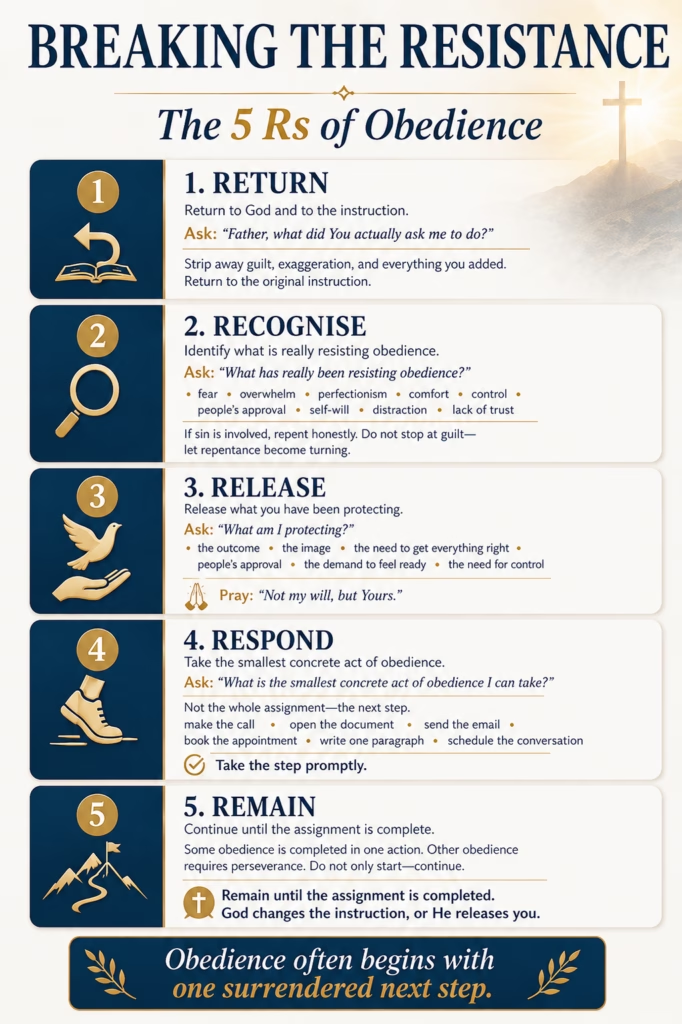
9. BREAKING THE RESISTANCE
THE 5 Rs: RETURN • RECOGNISE • RELEASE • RESPOND • REMAIN
We have identified many possible reasons for delayed obedience.
But insight alone is not enough.
Once the Holy Spirit reveals what is happening, we must respond.
Here is a simple pathway.
1. RETURN
Come back to God without hiding.
Do not begin with the assignment.
Begin with relationship.
Say:
“Father, I am here. I have delayed, but I am returning to You.”
Return without excuses.
Return without self-condemnation.
Return without pretending.
God is not waiting for a polished explanation.
He wants your yielded heart.
2. RECOGNISE
Ask the Holy Spirit to show you what is actually resisting obedience.
Is it fear?
Overwhelm?
Perfectionism?
Distraction?
Comfort?
People-pleasing?
Unbelief?
Self-will?
Poor planning?
Spiritual opposition?
Do not simply say:
“I procrastinate.”
Go deeper.
Ask:
“Why do I procrastinate particularly when I come near this assignment?”
You cannot surrender what you refuse to recognise.
3. RELEASE
Once the resistance is recognised, bring it under the lordship of Christ.
Release the fear.
Release the outcome.
Release the need for approval.
Release the demand for perfection.
Release the comfort.
Release control.
Release your preferred timing.
Release your right to obey only when you feel ready.
Pray:
“Lord, I give this to You. Not my will, but Yours.”
Surrender is where competing desires lose their governing authority.
4. RESPOND
Now take the next obedient step.
Not necessarily the whole assignment.
The next step.
Make the call.
Open the document.
Send the email.
Schedule the meeting.
Apologise.
Set the deadline.
Block the hour.
Ask for help.
Delete the distraction.
Begin.
Obedience becomes real when surrender becomes action.
Do not wait for a dramatic feeling.
Do what God has made clear.
5. REMAIN
Many people begin.
The deeper challenge is continuing.
Remain faithful after the emotion of starting has passed.
Remain when the assignment becomes repetitive.
Remain when progress is slow.
Remain when no one applauds.
Remain when you do not see immediate fruit.
Remain dependent on the Holy Spirit.
Jesus said:
“Abide in Me.”
— John 15:4
Follow-through is not sustained merely by determination.
It is sustained through dependence.
Return to God. Recognise the resistance. Release what competes with His will. Respond to the next step. Remain until obedience is completed—or until God redirects you.
10. PRACTICAL STRUCTURE CAN SERVE OBEDIENCE
Prayer and planning are not enemies.
Spiritual obedience may require very practical structure.
You may need:
- a calendar;
- a deadline;
- accountability;
- scheduled work time;
- fewer distractions;
- written steps;
- reminders;
- or help from someone with the right expertise.
Noah received a word from God—but he still had to build.
Nehemiah prayed—but he also planned, organised, assigned responsibilities, and rebuilt.
Sometimes we ask God to give us discipline while refusing to create the structures that would support disciplined action.
Prayer keeps us dependent. Structure helps us steward the instruction.
If God has told you to write, schedule writing time.
If He has told you to address something, decide when you will address it.
If He has told you to organise something, break it into steps.
If He has told you to stop something, remove the access that keeps making it easy to continue.
Structure is not a substitute for the Holy Spirit.
It can become a servant of obedience.
Reflection
What practical structure do I need to put in place to help me follow through with what God has asked me to do?
Do I need:
a deadline?
scheduled time?
written steps?
accountability?
fewer distractions?
help from someone?
11. WHAT IS GOD FORMING THROUGH FOLLOW-THROUGH?
The goal is not simply getting unfinished tasks completed.
God is doing something deeper.
Through follow-through, He may be forming:
- faithfulness;
- integrity;
- courage;
- self-control;
- perseverance;
- humility;
- trust;
- dependence;
- responsiveness.
Jesus said:
“I have finished the work which You have given Me to do.”
— John 17:4
Imagine being able to say before the Father:
“What You gave me to do, I completed.”
That is more than productivity.
That is stewardship.
That is worship.
That is the obedient life of Christ becoming visible through us.
Sometimes the assignment is not only about what God wants to accomplish through you.
It is also about what He wants to form in you while you are doing it.
Perhaps the unfinished assignment is exposing where perseverance still needs to grow.
Perhaps the conversation is forming courage.
Perhaps the discipline is forming self-control.
Perhaps the delay is exposing your need to trust God with outcomes.
Perhaps the process is teaching you dependence.
So do not only ask:
“Lord, when will this be finished?”
Ask:
“Lord, who are You forming me to become as I obey You in this?”
Reflection
What is God seeking to form in me through this unfinished assignment—not just accomplish through me?
Sample answers:
“God may be forming perseverance in me. I usually start with enthusiasm but struggle to continue when progress is slow, so this assignment is teaching me to remain faithful even when I do not feel motivated.”
“God may be forming trust and responsiveness in me. I tend to overthink and delay until I feel certain, but this assignment is teaching me to obey the next step and trust Him with the outcome.”
CALL TO RESPONSE
OUR YES MUST BECOME ACTION
Some of us do not need another instruction.
We need to honour the one we already received.
Some of us do not need stronger motivation.
We need surrendered wills.
Some of us do not need fear to disappear.
We need courage to obey while fear is still present.
Some of us do not need more time.
We need to stop giving God’s assignment only the time that remains after everything else has been done.
Some of us do not need another confirmation.
We need to return to what God has already made clear.
So bring one thing before the Holy Spirit now.
Not ten things.
Not every unfinished area of your life.
What is the one act of obedience He is bringing to your attention?
What have you decided to do but still have not done?
What happens inside you when you think about doing it?
What are you protecting?
What are you afraid of?
What preference is competing with His will?
What practical step have you been postponing?
And then ask:
“Holy Spirit, what is my next obedient step?”
Do not make another vague promise.
Make your yes concrete.
What will you do?
When will you do it?
What must change so that you can follow through?
But hear this clearly:
Jesus is not meeting us with condemnation.
He is calling us back into relationship, surrender, trust, and responsiveness.
Philippians 2:13 says:
“For it is God who works in you both to will and to do for His good pleasure.”
We do not obey alone.
The Holy Spirit is present to strengthen us.
The grace that awakened the desire to obey is also available to empower the doing.
But we must yield.
We must respond.
And eventually:
Our yes must become action.
CLOSING PRAYER
Father, in the name of Jesus, thank You for bringing into the light the places where we have sincerely intended to obey but have not followed through.
Holy Spirit, thank You for revealing what may lie beneath our resistance.
Where there is fear, strengthen us.
Where there is unbelief, deepen our trust.
Where there is perfectionism, teach us to begin.
Where there is overwhelm, show us the next step.
Where there is distraction, reorder our priorities.
Where there is avoidance, give us courage to face what we have been trying not to feel.
Where there is self-will, bring us again to surrender.
Where there has been deliberate delay, forgive us and restore responsiveness.
Where shame has made us hide, draw us back into the grace of Jesus.
Where spiritual opposition is present, teach us to submit to You and stand firmly against the enemy.
And where practical discipline is needed, give us wisdom to put the right structures in place.
Father, we release our need to control outcomes.
We release the approval of people.
We release comfort as our master.
We release the demand for perfect conditions.
We release the demand to feel ready before we obey.
And with Jesus we pray:
“Not my will, but Yours, be done.”
Work in us both to will and to do according to Your good pleasure.
Teach us not merely to intend, but to act.
Not merely to begin, but to continue.
Not merely to hear, but to do.
Not merely to say yes, but to live yes.
And may the faithful, surrendered, obedient life of Jesus become increasingly visible through us.
In Jesus’ name,
Amen.
FINAL TAKEAWAY
Wanting the result of obedience is not the same as being willing to do what obedience requires.
Our yes becomes obedience when it becomes action.
🎵 Prayer & Worship Atmosphere
Take a moment to quiet your heart before the Lord. Enjoy this instrumental worship as you explore the ministry.
