

Formation Through Spirit-Led Obedience
When the Holy Spirit Leads, Will You Follow?
CENTRAL TRUTH
Formation through Spirit-led obedience takes place when God speaks or convicts, we surrender our thoughts, emotions, and desires to His will, and the life of Christ becomes visible through our response.
ANCHOR SCRIPTURES
“If you love Me, keep My commandments.”
— John 14:15
“Be doers of the word, and not hearers only.”
— James 1:22
“For it is God who works in you both to will and to do for His good pleasure.”
— Philippians 2:13
INTRODUCTION — WHEN GOD SPEAKS, BUT WE DO NOT MOVE
One of the greatest dangers in the Christian life is not always that we cannot hear God. Sometimes, we have heard Him—directly, through His Word, or through others—yet we have not responded.
We knew we needed to forgive. We sensed the Holy Spirit prompting us to apologise. Someone came to mind, and we felt we should pray or call. We felt checked before speaking or sending a message. We knew we needed to fulfil a commitment.
But we delayed.
We dismissed the prompting. We waited for a stronger feeling, another confirmation, or a more convenient time. Then the moment passed.
The issue was not always that God had failed to speak. The issue was that we did not treat His Word or His leading as a priority.
Beloved, formation does not happen only while we are reading Scripture, praying, worshipping, or listening to a message. Formation becomes visible in what happens after God speaks.
What do we do when His Word confronts our attitude? How do we respond when His will crosses our preferences? What happens when obedience is costly, inconvenient, or uncomfortable?
James warns us not to be hearers only. We can underline the verse, record the prophecy, agree with the message, and still remain unchanged because revelation has not become obedience.
What God reveals, He calls us to respond to.
Reflection Question
What has God already made clear to me that I have heard and acknowledged, but have not yet acted upon?
1. WHAT IS SPIRIT-LED OBEDIENCE?
Spirit-led obedience is not legalistic rule-keeping. It is not obeying to earn God’s love or avoid His rejection. It is not acting under human pressure, guilt, fear, or manipulation. Neither is it treating every passing thought as though it came from God.
Obedience Is the Response of the Heart
Spirit-led obedience is not merely a religious mind following instructions. It is a heart responding to the God it knows, loves, and trusts.
A religious mind may comply outwardly while remaining inwardly resistant. It may follow rules because of fear, pressure, habit, or the desire to appear spiritual. But true obedience begins within.
Jesus said:
“If you love Me, keep My commandments.”
— John 14:15
Notice that Jesus connects obedience with love. Biblical obedience is not cold compliance. It is the response of a heart that says:
“Because I know You, I trust You.”
“Because I love You, I surrender to You.”
“Because You are Lord, I will follow You.”
The mind understands the instruction, but the heart yields to the One who gave it.
This is why two people may perform the same action while only one is truly obeying God. One may act from pressure; the other acts from relationship. One may protect an outward appearance; the other offers God a surrendered heart.
True obedience is not merely following God’s instructions as a religious duty. It is responding to His Word out of love for Him and a desire to please Him.
It involves four movements:
- Discernment — recognising what God is saying.
- Surrender — yielding our will to His.
- Trust — relying on His character when the outcome is unclear.
- Action — doing what He has made clear.
Obedience Requires Surrender
“Nevertheless not My will, but Yours, be done.”
— Luke 22:42
The struggle of obedience is often not that we do not know what God desires. The struggle is that His desire conflicts with ours.
He may call us to forgive when we want to remain offended, remain silent when we want to defend ourselves, speak when fear tells us to hide, wait when we want immediate movement, or confront an attitude we have justified for years.
The place where our will meets God’s will becomes a place of formation.
Obedience Is a Response of Faith
We obey because we trust God’s character. We may not understand everything He is doing, but we trust that He is wise, faithful, loving, and good.
Obedience asks:
Do I trust God enough to follow Him when I cannot control the outcome?
Obedience Is Governed by Scripture
The written Word of God is our final authority. The Holy Spirit will never lead us contrary to Scripture or the character of Jesus.
He will never prompt us to act dishonestly, immorally, vindictively, pridefully, or manipulatively.
The Spirit who inspired the Word will never contradict the Word.
Obedience Is Empowered by the Holy Spirit
“For it is God who works in you both to will and to do for His good pleasure.”
— Philippians 2:13
The Holy Spirit works within us to produce both the desire and the ability to do God’s will.
We must still surrender and respond, but we do not obey alone. The Spirit strengthens us to do what our flesh would rather avoid.
Reflection Question
Where is God asking me to move from recognising His will to surrendering, trusting, and taking action?
2. WE OBEY FROM ACCEPTANCE, NOT FOR ACCEPTANCE
Are you obeying God to become accepted, complete, or loved?
“And you are complete in Him.”
— Colossians 2:10
Obedience is not an attempt to complete what Christ has already accomplished. It is the yielded response of someone who is already loved, accepted, and complete in Christ.
Our practice of yieldedness does not make us complete. It allows the complete Christ who lives within us to be increasingly formed and expressed through us.
We do not obey so that the Father will love us. We obey because He has loved us.
We do not obey to become sons and daughters. We obey because, through Christ, we belong to the Father.
We do not obey to earn grace. We obey because grace empowers us to live differently.
Grace does not remove obedience. Grace makes true obedience possible.
Reflection Question
Am I obeying from the security of being loved and accepted in Christ, or am I still trying to prove my worth through performance?
3. JESUS: THE PATTERN OF OBEDIENCE
Jesus is not only the One we obey; He is the One we love, trust, and follow. His obedience flowed from relationship with the Father, and that same heart of loving surrender is what the Holy Spirit is forming in us.
“He humbled Himself and became obedient to the point of death, even the death of the cross.”
— Philippians 2:8
His obedience flowed from relationship with the Father. He knew the Father, trusted the Father, loved the Father, and desired the Father’s will above His own comfort.
In Gethsemane, Jesus did not pretend obedience was easy. He experienced deep anguish, yet He prayed:
“Not My will, but Yours, be done.”
Obedience does not mean we never feel afraid, troubled, or conflicted. It means our feelings do not become the final authority.
“Though He was a Son, yet He learned obedience by the things which He suffered.”
— Hebrews 5:8
Jesus was without sin. Yet as the Son who became human, He lived obedience through suffering, rejection, pressure, and pain.
He obeyed when obedience was costly.
He obeyed when He was misunderstood.
He obeyed when the outcome involved suffering.
This is the life the Holy Spirit is forming within us:
- Christ’s trust;
- Christ’s humility;
- Christ’s surrender;
- Christ’s responsiveness;
- Christ’s obedience.
Every time we say, “Not my will, but Yours,” the life of Jesus becomes more visible through us.
When Obedience Costs You Something
Costly obedience does not always involve a dramatic sacrifice. Often, it appears in ordinary moments where following God requires us to surrender comfort, convenience, approval, or control.
It may mean apologising when we believe the other person was also wrong; forgiving while the hurt is still real; keeping a commitment when it disrupts our plans; remaining silent when we want to defend ourselves; speaking truth when we fear rejection; serving when we feel tired; or obeying before we feel emotionally ready.
In these moments, discomfort does not necessarily mean we have missed God. It may be the place where our will is yielding to His.
The cost is real, but so is the formation.
As we surrender, the obedient life of Christ becomes visible through our response.
Reflection Question
What comfort, preference, approval, or sense of control may I need to surrender in order to obey God fully?
4. WHY DO BELIEVERS DELAY OBEDIENCE?
Many believers sincerely love God but still struggle to obey Him promptly. Often, the issue is not open rebellion. It is an inward conflict between what God is saying and what another desire, fear, or priority is demanding.
Can you recognise yourself in any of these reasons?
A. I Do Not Fully Trust God
We may trust God with eternity but struggle to trust Him with our reputation, relationships, finances, comfort, future, or plans.
We may never say, “God, You are wrong,” yet our delay may reveal that we believe our wisdom or timing is safer than His.
Fear magnifies the cost of obedience while hiding the cost of disobedience.
B. I Want God’s Help Without His Government
We want God’s provision, protection, promises, and presence, but we may resist His authority over our attitudes, decisions, relationships, and timing.
Jesus is not only Saviour. Jesus is Lord.
He has the right to interrupt, correct, redirect, and govern us.
C. I Fear the Cost and Prefer Comfort
Sometimes we know what to do, but we fear rejection, embarrassment, sacrifice, disruption, or loss of control.
Saul admitted:
“I feared the people and obeyed their voice.”
— 1 Samuel 15:24
Obedience may require a humbling apology, expose an attitude, interrupt our plans, or ask us to act before we feel ready.
Courage is not the absence of discomfort. It is choosing God’s will while discomfort is still present.
D. I Allow Busyness to Crowd Out Obedience
Sometimes we are not refusing God outright. We are simply too occupied to respond.
Our schedules are full. Our minds are distracted. One responsibility follows another, and what God prompted us to do keeps being pushed aside.
We may tell ourselves:
“I will pray when things settle down.”
“I will call when I finish everything else.”
“I will deal with that issue when I have more time.”
But busyness can become a form of avoidance when everything else is repeatedly given priority over what God has made clear.
A full schedule does not excuse an unresponsive heart. Sometimes obedience requires us to stop, reorder our priorities, and make room for what matters to God.
E. I Procrastinate
We intend to obey, but continually move the action into the future:
“I will begin tomorrow.”
“I will apologise later.”
“I will become consistent next week.”
“I will obey when I have more time.”
Eventually, postponement becomes a pattern of resistance.
Reflection Question
What most often delays my obedience: lack of trust, fear, comfort, control, human approval, busyness, or procrastination?
5. WHEN DELAY SOUNDS SPIRITUAL
Disobedience does not always sound rebellious. Sometimes it sounds spiritual:
- “I am still praying about it.”
- “I need another confirmation.”
- “I do not feel peace.”
- “The timing does not feel right.”
- “God knows my heart.”
There are times when prayer, counsel, wisdom, and discernment are genuinely necessary. We should never act carelessly on an untested impression.
But when Scripture is clear and the Holy Spirit has repeatedly convicted us, continued prayer can become a way of postponing surrender.
We can ask for confirmation when we really want permission not to obey.
We can say we are waiting on God when God is waiting on our response.
We can call fear “wisdom,” avoidance “peace,” procrastination “timing,” and partial obedience “progress.”
Saul did this in 1 Samuel 15. God gave him a clear instruction, but Saul obeyed selectively and then justified his actions with religious language.
Samuel responded:
“To obey is better than sacrifice.”
Religious activity cannot substitute for obedience. We cannot worship our way around an instruction we refuse to follow.
The deeper question is:
Am I sincerely seeking clarity, or am I delaying what God has already made clear?
Delay May Reveal a Lordship Issue
Not every delay is deliberate rebellion. Some believers are sincerely seeking clarity. Some are spiritually immature. Some are wrestling with fear. Others have experienced spiritual manipulation and need wisdom to distinguish God’s leading from human pressure.
God is patient with weakness.
However, when His instruction is clear and we repeatedly postpone our response, delay begins to reveal what is governing the heart.
Delay may quietly say:
- “My timing is better.”
- “My comfort matters more.”
- “I will obey when I am ready.”
- “I recognise what God said, but I remain the final authority.”
Delayed obedience is not always merely a time-management issue. It may be a lordship issue.
But God is merciful.
Peter failed, and Jesus restored him. Grace does not leave us in shame. Grace brings us back to relationship, surrender, and responsive obedience.
Reflection Question
Is there an area of my life where I acknowledge Jesus as Saviour but still resist His government as Lord?
6. COMMANDS, PROMPTINGS, AND DISCERNMENT
We must distinguish between the clear commands of Scripture and the personal promptings of the Holy Spirit.
The Commands of Scripture
Scripture commands every believer to forgive, love, pray, speak truth, refuse bitterness, flee immorality, honour commitments, care for others, and walk humbly.
We do not need a special word to obey what Scripture has already made clear.
We may need grace to forgive, but we do not need another confirmation that forgiveness is God’s will. The Word has already spoken.
The Promptings of the Holy Spirit
The Holy Spirit also applies biblical truth to specific situations.
He may bring someone’s name to mind and prompt us to pray. He may remind us to call or encourage someone. He may check us before we speak. He may impress upon us to apologise, give, wait, serve, or remain silent.
These promptings do not create new doctrine. They apply God’s truth and character to a particular moment.
Before acting on a prompting, ask:
- Is it consistent with Scripture?
- Does it reflect the character of Jesus?
- Am I being led or driven?
- Does the seriousness of the decision require counsel or confirmation?
- Will it honour Christ and produce godly fruit?
Simple acts of prayer, encouragement, kindness, or restraint may require an immediate response. Major decisions involving marriage, relocation, financial investment, or leadership require prayer, wisdom, and mature counsel.
We should not dismiss every gentle thought, but neither should we treat every passing thought as divine.
We test, discern, and respond.
Reflection Question
Do I test promptings through Scripture and the character of Jesus, or do I dismiss them too quickly or accept them too carelessly?
7. DO NOT DISMISS THE GENTLE NUDGE
Many believers expect God to speak dramatically. We look for a vision, an audible voice, a prophecy, or an overwhelming experience.
But the Holy Spirit often leads gently.
His prompting may come as a quick thought, a quiet reminder, a check in the spirit, a Scripture brought to mind, a person’s name that keeps returning, or a sense that we should pray, call, apologise, give, wait, or remain silent.
Because it comes quietly, we may dismiss it:
“That was probably just me.”
“It cannot be that important.”
“I will do it later.”
But sometimes that quick thought is the Holy Spirit drawing our attention to an opportunity for obedience.
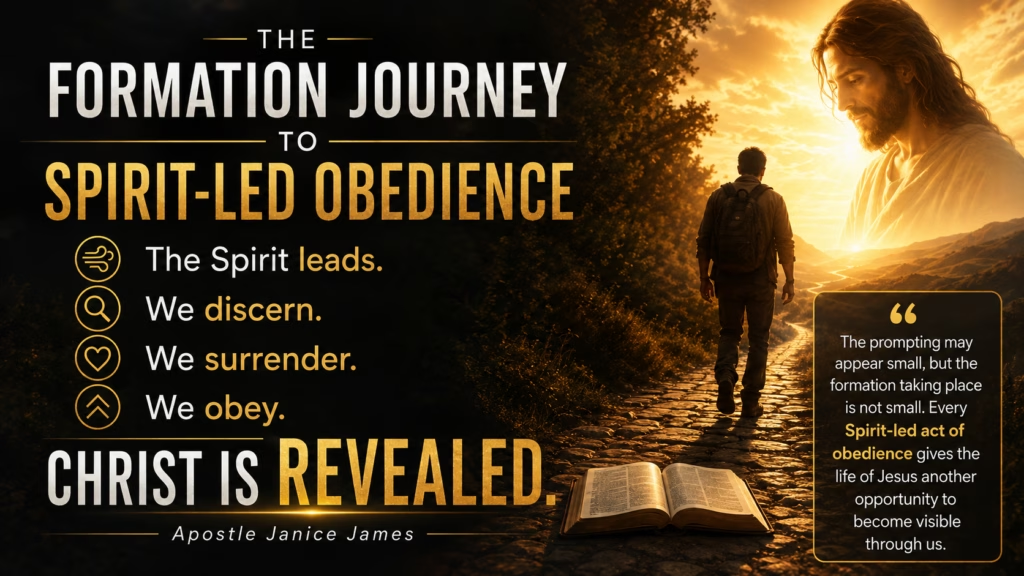
The prompting may appear small, but the formation taking place is not small.
Through a prompting to call, God may be forming compassion.
Through a prompting to remain silent, He may be forming self-control.
Through a prompting to apologise, He may be forming humility.
Through a prompting to pray, He may be developing spiritual sensitivity.
Through a prompting to fulfil a responsibility, He may be forming faithfulness and integrity.
The action may appear ordinary, but Christ is being revealed through the response.
Repeatedly ignoring these promptings can affect our sensitivity. First, we sense the prompting. Then we delay. Eventually, it becomes easier to dismiss.
The issue may not be that the Holy Spirit has stopped speaking. It may be that we have become accustomed to not responding.
“Do not quench the Spirit.”
— 1 Thessalonians 5:19
Yet we should not become fearful or anxious about every passing thought. We are called to cultivate a Scripture-shaped, Christ-centred attentiveness to the Holy Spirit.
When we miss a prompting, the answer is not condemnation. It is repentance, renewed sensitivity, and a willingness to respond again.
Reflection Question
What gentle prompting have I recently dismissed or delayed, and what might the Holy Spirit have been forming in me through it?
Prompt Obedience Is Not Impulsive Obedience
Prompt obedience does not always mean hurried action. It means responding without unnecessary resistance.
If the Holy Spirit checks us before we speak harmful words, the time to obey is now.
If Scripture confronts dishonesty, bitterness, unforgiveness, or neglect, we should not delay surrender.
If someone comes strongly to mind, we can pause and pray.
Other matters require preparation, counsel, and appropriate timing.
Prompt obedience is not recklessness. It says:
- “I will not resist what God has made clear.”
- “I will take the next faithful step.”
- “I will seek wisdom where wisdom is needed.”
- “I will not use discernment as an excuse for indefinite delay.”
You may not be able to complete the entire assignment immediately, but you can take the next obedient step.
You may not know the whole plan, but you can make the call.
You may not feel fully prepared, but you can still say yes to God.
Reflection Question
What is the next faithful step I can take without acting recklessly or delaying unnecessarily?
8. EVERYDAY OBEDIENCE REVEALS CHRIST
“My little children, for whom I labour in birth again until Christ is formed in you.”
— Galatians 4:19
Christ lives within the believer, but His character must increasingly become visible through our responses.
Formation is revealed when we:
- apologise without being forced;
- forgive without receiving an apology;
- receive correction without immediately defending ourselves;
- follow through on our commitments;
- remain silent when our flesh wants to retaliate;
- pray when the Spirit brings someone to mind;
- wait without manipulating the outcome.
You may think the issue is simply making a call. God may be forming compassion.
You may think the issue is simply apologising. God may be overthrowing pride.
You may think the issue is simply completing a task. God may be forming faithfulness.
You may think the issue is simply remaining silent. God may be forming the self-control of Christ.
The action is temporary. The formation is eternal.
This is how our formation journey connects:
- Walking with the Holy Spirit teaches us to recognise His leading.
- Correction develops humility.
- Guarding the heart protects what God is forming.
- Life and peace help us recognise the government of the Spirit.
- Breaking old patterns withdraws agreement from the former life.
- Believing God develops trust.
- Spirit-led obedience carries revelation into action.
The formation journey to Spirit-led obedience is simple:
The Spirit leads.
We discern.
We surrender.
We obey.
Christ is revealed.
Reflection Question
What quality of Christ is the Holy Spirit seeking to reveal through my response today?
CALL TO RESPONSE
Final Reflection Question
What is the last clear instruction, Scripture, responsibility, or prompting from God to which I now need to return and respond?
Perhaps the Holy Spirit is showing us that we have treated His leading casually.
We have asked for new revelation while ignoring what He previously revealed.
We have delayed because obedience was inconvenient.
We have dismissed gentle promptings because they did not come dramatically.
We have called procrastination wisdom, fear discernment, and partial obedience faithfulness.
But Jesus is not calling us into condemnation. He is calling us back into relationship, responsiveness, and surrender.
His mercy is present.
His grace is available.
His Spirit is ready to strengthen us.
We can repent.
We can return.
We can obey.
Do not begin by asking God for another assignment.
Return to the last thing He made clear.
Return to the Scripture you avoided, the apology you delayed, the commitment you neglected, or the prompting you repeatedly dismissed.
Ask the Holy Spirit for courage.
Then take the next faithful step.
CLOSING PRAYER
Father, in the name of Jesus, thank You that we are loved, accepted, and complete in Christ.
Forgive us for the times we heard Your Word but did not respond. Forgive us for delayed obedience, partial obedience, and the promptings we dismissed. Forgive us for valuing comfort, control, convenience, or human approval above surrender.
Holy Spirit, search our hearts. Reveal where fear has disguised itself as wisdom, procrastination as timing, and self-government as discernment.
Restore our sensitivity to Your voice. Teach us to recognise Your gentle leading and test every prompting by Scripture. Give us courage to respond without unnecessary delay.
Form within us the trust, humility, surrender, responsiveness, and obedience of Jesus.
Let our hearing become action.
Let revelation become responsibility.
Let worship become a yielded life.
When You lead, help us to discern.
When You speak, help us to surrender.
When You strengthen us, help us to obey.
May Christ become increasingly visible through our daily responses.
In Jesus’ name. Amen.
CLOSING DECLARATION
I am accepted and complete in Christ.
I do not obey to earn the Father’s love. I obey because I am loved and because Jesus is Lord.
The Holy Spirit is working within me, giving me the desire, grace, and strength to do God’s will.
I will test every prompting by Scripture.
I will not continually postpone what God has made clear.
As I discern, surrender, and obey, the life of Christ will be revealed through me.
In Jesus’ name. Amen.
TAKEAWAY
True obedience is not simply doing what God said. It is responding to God Himself through what He said.
🎵 Prayer & Worship Atmosphere
Take a moment to quiet your heart before the Lord. Enjoy this instrumental worship as you explore the ministry.
